





In 2013, about 21% of 18–24 year olds — nearly one million young people — were unemployed in the UK. And yet, in many sectors — particularly areas like science, technology, engineering and mathematics (STEM) – industry faces a skills shortage.
The Government has done a good job to provide the right “push” towards a solution, through education and training schemes. It is industry that creates jobs and it is industry which can provide the demand side “pull” to attract more young people into apprenticeships and graduate training schemes. Doing this can help transform the work-place skills and abilities in the UK, and at the same time, improve the prospects of Britain’s youth.
Business is getting behind the 5% club…
This drove the creation of The 5% Club an industry-led campaign spearheaded by Leo Quinn, QinetiQ Group CEO. The 5% Club are companies, including FTSE100 and SME members, from a diverse range of sectors. Each member aspires to have at least five per cent of its UK workforce comprised of apprentices, graduates or sponsored students.
Members also commit to publicly declaring in their Annual Reports or equivalent document, the progress being made. By mobilising business to act in concert, members of The 5% Club can ensure that industry makes a positive difference to the next generation of workers — and to Britain’s long-term success in increasingly tough global markets.
There is real appetite for this type of change: The 5% Club began with six founding members. There are now 38 members and it is growing including: Balfour Beatty, KPMG, Thales, Babcock, Vision Express, Pinsent Masons and Redrow Homes.
There are also several SMEs which have joined the campaign. Each of those smaller companies know that despite other pressures, skilling their future workforce is vital to their existence.
Since its launch last October, The 5% Club has received widespread support from various quarters, including politics.Earlier this year the then UK Skills Minister, Matt Hancock said that he welcomed:
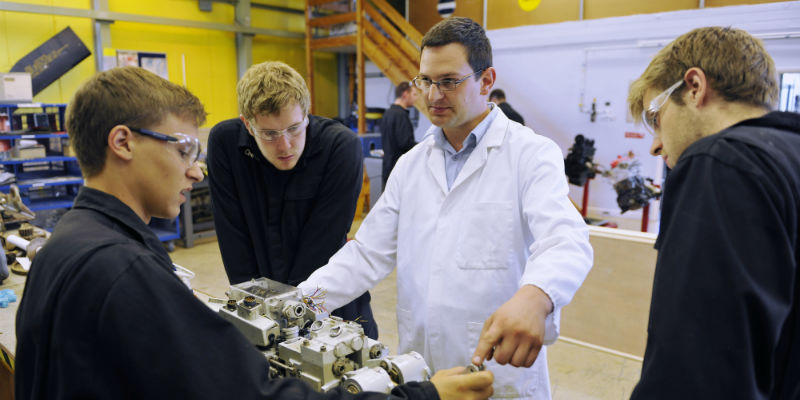
One view from the younger generation is given by Tom Wheatley, a third year QinetiQ Aeronautical Apprentice. who says:
…but there is more to do
Since the Club was launched there has been an upward curve in the economy and as a result, youth unemployment has started to fall. Official figures from July 2014 showed that youth unemployment in the UK fell to 817,000 unemployed people, the lowest number for five years. But this is still too high and it is recognised that there is still a shortage of skills among young people.
Everyone who is concerned with the up-skilling workforce should be prepared to roll up their sleeves and convince business leaders that increased investment in young people is the key to a better future.
Companies do not have infinite funds but many realise that one of the greatest investments they can make is in the next generation. It is vital to the UK’s future prosperity if we are to compete on the international stage and vital to building a fairer society for young people.